
Guide · Smart recycling
What is a smart recycling station? What institutions should look for
The “smart” label is applied today to everything from a bin with a fill-level sensor to a machine that recognises packaging and refunds a deposit. This article separates the concepts and lists the questions to ask before buying or leasing.
In short: what is a smart recycling station?
A smart recycling station is a separate-collection point that does three things at once: it recognises the waste (what is being dropped off), records it (how much, when, where) and sends this information to a system (for fill levels, collection and reporting). Most models add a fourth: identifying and rewarding the user. The person dropping off the waste is identified through an app, QR code or card, and their contribution comes back as points, discounts or donations.
A conventional recycling bin also collects waste separately, but how much was collected is only learned at emptying time, usually by estimate. With a smart station that information is created automatically with every drop-off.
Three concepts that are often confused
| Device | What it does | What it doesn't do |
|---|---|---|
| Smart (sensor) bin | Measures the fill level and notifies the collection team; helps shorten collection routes. | Doesn't recognise the type of waste, doesn't know the user, doesn't separate wrongly placed waste. |
| Reverse vending machine (RVM) | Recognises beverage packaging that carries a deposit mark, accepts it and refunds the deposit. | Usually doesn't accept waste outside the deposit scheme (cardboard, non-deposit packaging, batteries, small electronics, etc.). |
| Smart recycling station | Accepts several waste types at one point, recognises the type, links each drop-off to a user and reports the data. | Doesn't solve collection logistics on its own; it must work together with an emptying and maintenance plan. |
Türkiye's deposit return system (DOA), which went live in all 81 provinces on 1 July 2026, makes this distinction even more important. Deposit refunds for DOA-marked PET, glass and aluminium beverage containers between 0.10 and 3.01 litres run through DOA's own machines and return points. A general-purpose station installed by an institution cannot pay out deposits for these containers unless it is authorised as a DOA return point. So the right question is not “which one?” but “on my site, which waste goes through which channel?”
Five components of a good station
- Recognition: identifying the waste type (plastic, metal, glass, paper, etc.) with cameras and/or sensors. What matters is how recognition accuracy is measured in the field.
- Sorting and compartment management: making sure the waste goes into the right compartment and tracking the fill level of each one separately.
- User matching: linking each drop-off to a person or account. Participation and repeat rates can only be measured this way.
- Connectivity and power: mobile data or wired connection; grid power, solar panels or both. This directly determines where the station can be installed.
- Institutional dashboard: collected volumes, fill levels, participation and period reports on a single screen, with data export.
7 questions to ask when choosing
1. Which waste types does it accept, and which does it not?
If the device's accepted list doesn't match the waste profile on site, the station quickly fills with the wrong waste. On a campus coffee cups may dominate, in a mall cardboard packaging, in a housing complex batteries and small electronics. Start with a simple one- or two-week waste count on your site.
2. How is recognition accuracy measured?
“Recognises waste with AI” says nothing on its own. Ask: for which waste types, with how many samples, tested in the field or in a lab; and what happens to misrecognised items (rejected, or sent to a mixed compartment)?
3. In what format is the data, and who owns it?
The institution should be able to export the data generated on its own site (Excel/CSV or API). For municipalities and institutions with zero-waste obligations in Türkiye, it also matters that the data can be turned into the items reported in period reports and in the national Zero Waste Information System.
4. Who empties and maintains it, and how often?
The real cost of a station is often operations, not the device. Who receives the fill-level alert, which licensed collector takes the emptied waste, and what is the response time for faults?
5. Why would users come back?
Users who come out of curiosity in the first week stop if they see nothing in return. An incentive such as points, discounts, donations or an internal competition, and who pays for it, must be clear from the start.
6. What is the acquisition model?
Purchase, lease, software licence or sponsor-supported installation. For municipalities and public institutions the budget line and procurement procedure drive the decision; for the private sector, payback time and contribution to the ESG report.
7. How will the pilot be measured?
Agree on 3–5 criteria before installation: volume collected (kg, by type), contamination rate, active users and repeat rate, number of emptying runs and station uptime. Ask for a report against these criteria at the end of the pilot.
Practical tip: Ask every supplier you get a quote from to answer the same list of criteria in writing. The comparison should be decided by measurable results on your site, not by brochure features.
Why now?
Türkiye's zero-waste target has been set at a 60 percent recovery rate by 2035. For many types of buildings, such as public institutions, educational institutions and large commercial spaces, a zero-waste management system is already an obligation. As the target grows, “we collect separately” is no longer enough; you need to be able to show how much you collect, who takes part and what is changing. That is where the real value of a smart station lies: it doesn't just collect waste, it makes measurement a natural part of daily operations.
Coreva's approach
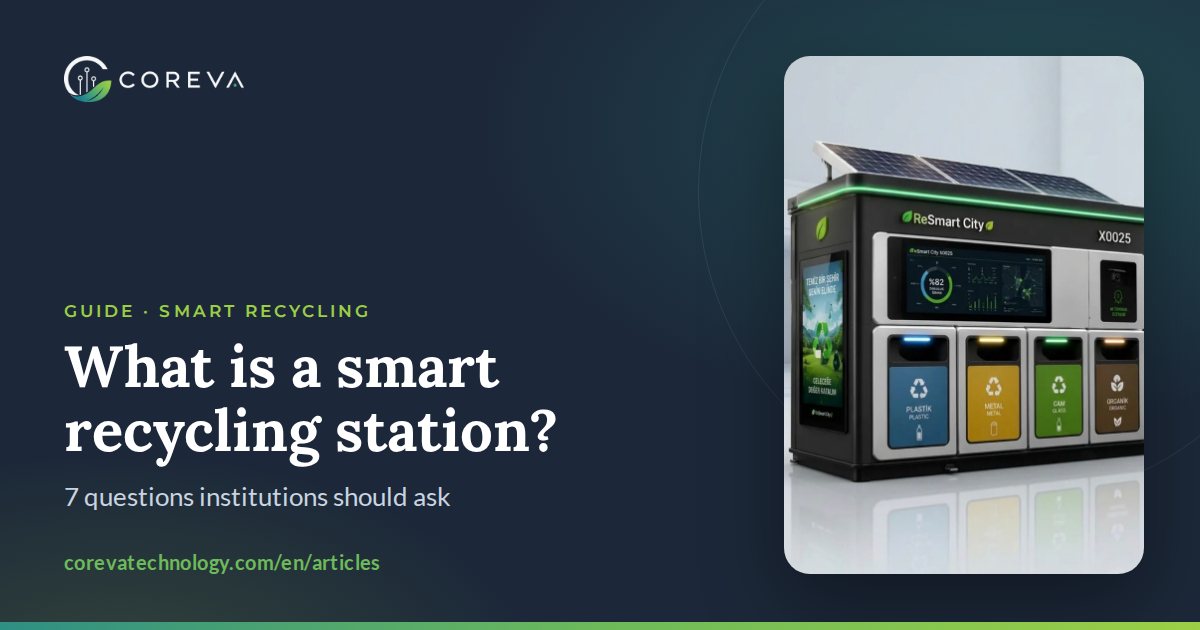
ReSmart X0025 is our station designed to collect glass, plastic, metal packaging, batteries and small electronic waste at a single point; it is currently at the prototype stage. We design the station together with the ReLuca citizen app and the institutional dashboard as a single system. We run the first installations with a small number of pilot partners and agree the success criteria together before installation.
Sources
- Zero Waste Regulation (Sıfır Atık Yönetmeliği), Official Gazette 12.07.2019, No. 30829 – mevzuat.gov.tr (Turkish)
- DOA – How it works (doa.gov.tr)
- Zero Waste: 60% recovery target for 2035 (sifiratik.gov.tr, 27.09.2024, Turkish)
Regulatory and implementation details may change; rely on official sources for current provisions. Most sources are in Turkish. This article is not legal advice.