
Municipalities · Zero waste
Zero-waste reporting for municipalities: which data, from where, how often?
In most municipalities the zero-waste report is put together twice a year from documents collected at the end of the period. Yet the same data could be generated daily and used for decisions. This article covers the obligation, the measurements that are usually missing, and a practical data setup.
What does the obligation say?
Türkiye's Zero Waste Regulation, published in the Official Gazette on 12 July 2019, makes municipalities responsible for setting up and running a zero-waste management system. Two provisions stand out for reporting:
- Registration: municipalities must register in the Zero Waste Information System (Sıfır Atık Bilgi Sistemi) and record the information and documents requested about their activities (Art. 9).
- Reporting frequency: data on all collected waste and on where it was delivered is reported through the system twice a year, in January and July (Art. 9).
The regulation defines the Zero Waste Information System as the online system set up by the Ministry to register, certify and monitor the places implementing the system and to ensure the traceability of the waste they manage (Art. 4). The same reporting obligation applies to the buildings and campuses listed in the regulation, such as public institutions and educational institutions (Art. 10).
Why is the report usually based on estimates?
Reporting happens twice a year, but for six months the data piles up in scattered places: weighbridge slips from collection vehicles, delivery documents from licensed facilities, spreadsheets kept by neighbourhood, records of periodic campaigns. Merging them at the end of the period takes time and creates three problems:
- No visibility by collection point: the total is known, but not which neighbourhood, container or station contributed.
- Quality isn't measured: how much of the separately collected waste is rejected at the facility as contamination rarely makes it into the report.
- Participation isn't measured: without knowing how many households or people sort regularly, the effect of awareness campaigns can't be evaluated.
8 indicators worth measuring
Beyond the items needed for the legal report, these indicators make decisions easier:
| Indicator | What it shows | Data source |
|---|---|---|
| 1. Separately collected waste (kg, by type) | Size of the system | Weighbridge slip, station record |
| 2. Waste sent to disposal (kg) | Denominator of the recovery rate | Landfill / disposal records |
| 3. Recovery rate (%) | Distance to target | Calculated from 1 and 2 |
| 4. Contamination rate (%) | Quality of collected waste | Facility feedback, station recognition log |
| 5. Collection per point (kg/day) | Which points perform well | Station / container records |
| 6. Active participants and repeat rate | Whether behaviour sticks | App or card records |
| 7. Fill level per emptying (%) | Efficiency of collection runs | Fill-level sensor |
| 8. Collection cost per tonne (₺) | Economic sustainability | Vehicle, fuel and staff costs |
Calculation note: the recovery rate is tracked as the share of separately collected waste sent for recovery in the total waste generated. Using the same period and the same boundaries (district, neighbourhood, campus) in numerator and denominator is essential for comparisons between periods to be valid.
In the context of the national target
The Ministry announced that Türkiye's recovery rate reached 36.08 percent as of 2024, with a target of 60 percent for 2035. This gap turns the municipal question “how much did we collect?” into “where are we collecting less, and why?”. Answering the second question requires data that is generated continuously and by collection point.
A practical data setup in four steps
1. Draw the boundary
Define in writing which area the report covers (the whole district, a pilot neighbourhood, a specific campus) and the starting period. Without a baseline, improvement can't be shown.
2. Consolidate the sources
Weighbridge slips, facility delivery documents and field records should go into a single table, in the same unit (kg) and with the same coding. Matching waste codes to the items in the Zero Waste Information System turns the January and July reports into a copy-and-paste job.
3. Make every point measurable
Each collection point needs an ID. Smart stations create this record automatically with every drop-off; with conventional containers, weighing can be done by point ID at emptying.
4. Look monthly, report twice a year
Even though the legal report is twice a year, reviewing the indicators monthly makes it possible to spot under-performing points and neighbourhoods before the period ends. Decisions such as moving a container or running a campaign in a neighbourhood can then be taken in time.
Why citizen participation belongs in the report
In zero waste, the hardest variable isn't infrastructure, it's behaviour. The same number of containers can produce very different results in two neighbourhoods. Measuring participation determines where the awareness budget should go. Apps that offer rewards or feedback are one way both to increase and to measure participation; however, processing personal data in line with Türkiye's data protection law (KVKK) and collecting only what is necessary must be designed in from the start.
Coreva's approach
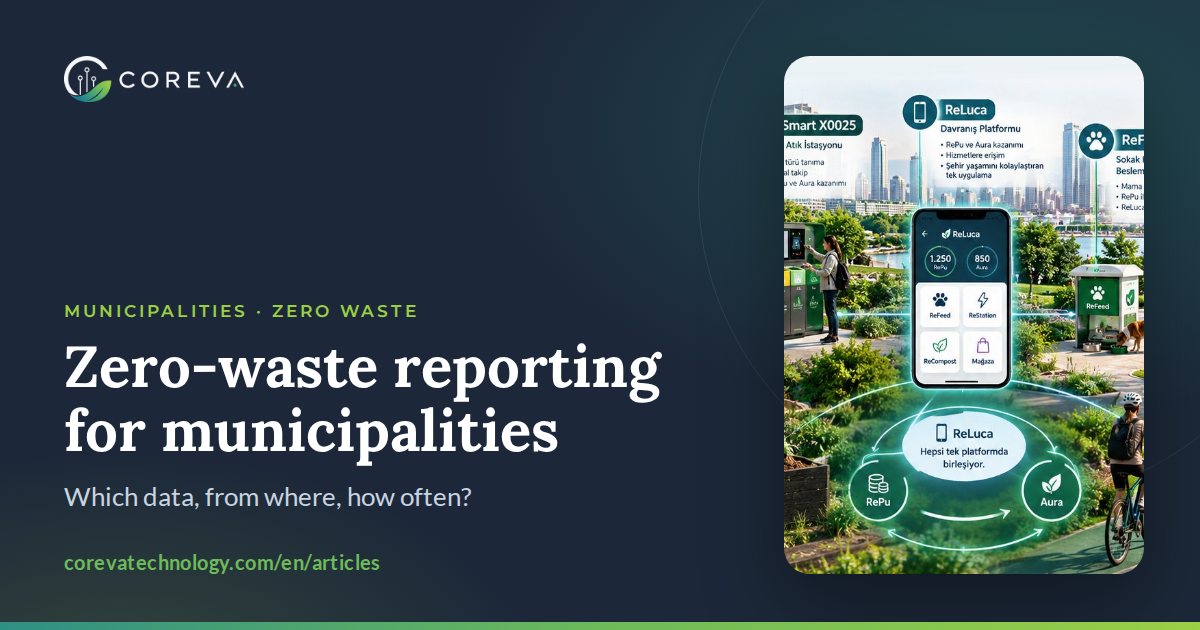
Coreva's system is being designed to combine drop-off records from stations, participation data from the ReLuca app and fill-level information in an institutional dashboard. The aim is for the period report to stop being a document-gathering exercise and become a management tool reviewed every month. Our products are at the development and prototype stage; we run the first installations with pilot partners and agree the criteria together from the start.
Sources
- Zero Waste Regulation, Art. 4, 9 and 10 (Official Gazette 12.07.2019, No. 30829) – copy on meb.gov.tr (Turkish)
- Zero Waste Regulation – mevzuat.gov.tr (Turkish)
- “We have raised our recovery rate to 36.08 percent” (sifiratik.gov.tr, 30.03.2025, Turkish)
- 60% recovery target for 2035 (sifiratik.gov.tr, 27.09.2024, Turkish)
Regulatory and implementation details may change; rely on official sources for current provisions. Most sources are in Turkish. This article is not legal advice.